
North American Crop Prospects
- Monday, April 19, 2004
This analysis featured in the April 19, 2004 issue of the HGCA's MI Prospect, Volume 6, Number 21
Key points
- US Wheat Plantings Lower
- Impact of US wheat S&D on international markets limited
- Canadian oats and barley stock to recover
- Good Canadian malting barley supplies possible
Although winter wheat only about eight weeks from harvest close to the Mexican border at the southern extremity of the US winter growing area, spring cultivation is yet to start over much of the Canadian prairies. The threat of drought has abated in the US, but still threatens on the Canadian Prairies. North American grain and oilseed production prospects are only now beginning to take shape. Forward market prices, however, already appear relatively favourable for most crops for a third successive year.
US Winter Wheat
US farmers planted about 24.1 million hectares to winter wheat this year, about three percent less than last year, see Table 1. Planting conditions were generally favourable last autumn and the decline in area appears to reflect better prospects for spring planted feed grain and oilseeds where they are a cropping option.
Table 1: US Prospective Plantings
----------------------------------------------------
                  Actual Actual Prospect Change
                   2002   2003    2004	  2004/03
                   Mhct.  Mhct.   Mhct.	 percent
----------------------------------------------------

Corn               32.0   31.86   31.97     0.3
Soybeans           29.8   29.71   30.52     2.7
All Wheat          24.4   24.97   24.06    -3.6
Winter wheat       16.9   18.19   17.55    -3.5
Durum              1.20    1.18    1.12    -5.4
Other spring Wheat 6.40    5.60    5.40    -3.7
Oats               2.00    1.86    1.75    -6.3
Barley             2.10    2.14    1.90   -11.6
Sunflowers         1.00    0.95    0.84   -11.1
Canola             0.60    0.44    0.39   -10.7
----------------------------------------------------
Source: USDA March 31, 2004
Early USDA crop progress assessments indicate the condition of the winter wheat crop is relatively favourable. With 48 percent of the crop rated in early April as in good to excellent condition, crop development remains belwo that of last year, but has improved on the previous two years. Also this year's crop lost less condition than other recent crops over the winter.
In view of the somewhat smaller area of winter wheat and crop development to date not very different from last year, it would be reasonable to expect a crop of rather less than last years 47.3 million tonnes, perhaps about 45 million tonnes. A crop of this size is not large by standards of ten years or more ago, but appears somewhat standard by more recent experience.
Given that last year's crop was not large enough to meet forecast export and domestic demand, a further decline in carryover stocks from the relatively low level of a year ago is expected. With the prospect of 2004 US winter wheat harvest, which accounts for 75 percent of total US wheat output, smaller than a year ago, it is quite possible that the US wheat supply situation will not have an adverse impact on international markets.
US Spring Crops
The rate of growth in the area planted to maize and soybeans, evident following the implementation of the 1996 Freedom to Farm Act which encouraged changes in cropping patterns, has slowed(Graph 1). What growth continues is probably the result of the development of more drought resistant maize varieties allowing it to be grown in previously marginal conditions replacing wheat and sorghum. At the same time and under current market conditions, including high fertilizer costs, traditional maize area is being planted to soybeans and to cotton in the south.
continue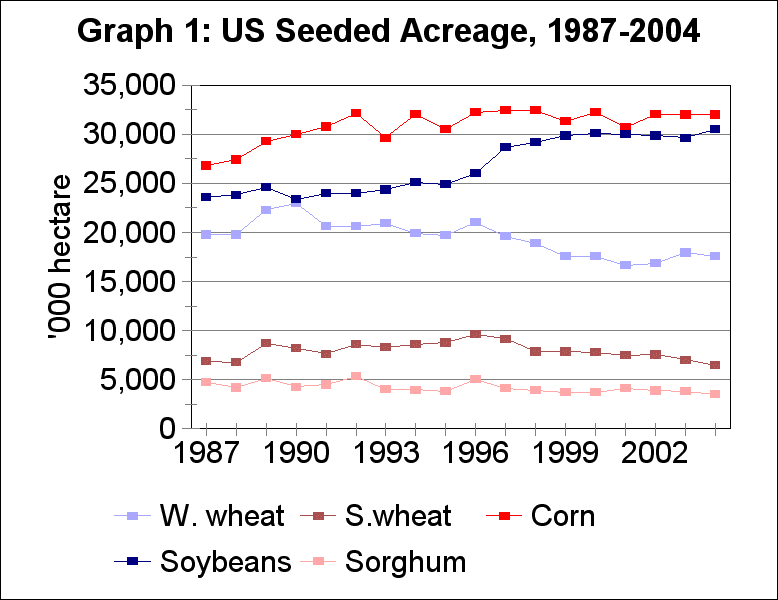 Source: USDA
continued
US drought conditions in the main only persist in uncultivated area of the high plains. The exception to this is against the Canadian border and particularly in Montana. The USDA perspective plantings survey estimated the spring wheat acreage at only 6.5M hectares, about four percent below last year and about two thirds of what might be planted if moisture and economics conditions for wheat were favourable. Perspective plantings of durum wheat at 1.12M hectares are down five percent and as with other spring wheat about two thirds of what in the past would have been expected under favourable moisture and economics conditions.
The demand-generated competiton for planted area between maize and soybean appears to have been won this year by soybeans, but by a narrow margin with maize drawing area from other crops. Perspective soyabean plantings are a record 30.5 million hectares, up three percent, with 86 percent being seeded to genetically modified varieties, up from 81 percent last year.
Maize acreage at 32.0M hectares is about unchanged from a year ago, with 46 percent being seeded to genetically modified varieties, up from 40 percent last year.
Canada
Given favourable market prospects, Canadian farmers like US farmers will tend to switch to oilseeds. The switch would be quite dramatically to canola on the Prairies, but also with soybeans in eastern Canada.
This expectation may, however, be foiled by the moisture situation. Excellent moisture conditions last spring resulted in the 2003 crops getting away to an excellent start despite very poor subsoil conditions over much of the western Prairies. During an exceptionally hot and dry summer crops used up the spring moisture returning the prairies sub soil moisture to where it had been a year previously. Since harvest it has been wetter than usual over much of Manitoba but much drier over Alberta, with Saskatchewan in between.
The reality is, however, that, other things being equal, farmers will not risk seeding canola into a dry seed bed. It is, therefore, evident that even Statistics Canada's Seeding Intentions survey report, not published until April 23, may not provide a very reliable indication of eventual areas if conditions remain dry.
Last year's crops have not resulted in much of a recovery in the Canadian supplies even though grain and oilseed exports have generally snapped back from their drought starved levels of the previous year. In the case of barley and oats year end stocks are expected to recover from the very low levels of last summer. For wheat there is expected to be a very limited rebuilding of stocks, but canola carry over stocks are expected to decline.
Even with above average crops, which would require both favourable amounts and timing of moisture this spring and summer, Canadian grain and oilseed supplies are unlikely to pressure international markets. The possible exception to this is the situation for malting barley. Favourable weather prior to and at harvest could result in abundant supplies of Canadian barley of malting quality. The prospect for which has already provided a negative tone to the forward market.
New Crop Prices
New crop futures' prices and Canadian Wheat Board pool return outlooks' confirm the rather positive market prospects for North American grain and oilseed for 2004-05, see Table 2. In most cases new crop prices are above the five-year averages which include two years when prices were driven by drought conditions, particularly in Canada. The exception to this is for malting barley. Although the overall supply situation for barley may remain tight and there is no reason to doubt at this time the quality of the crop and thus the availability of malting quality supplies.
Table 2: Current price prospects
----------------------------------------------====--
                                 March'04  5-yr.arg.
----------------------------------------------------
US, US$ per bushel
Wheat, Dec, Chicago contract         4.04       3.01
Maize, Dec, Chicago contract	     3.00       2.18
Soyabeans, Nov, Chicago contract     7.54       5.42
Canada, Can$ per tonne
Wheat, 1CWRS, 13.5%, CWB Pool      217.00     214.85
Barley,SSCW2-row(malting),CWB Pool 182.00     206.64
Canola, Nov, Winnipeg contract     377.00     335.79
----------------------------------------------------
Source: HGCA & Canadian Wheat Board
David Walker
'phone: 01603 705153
top of page